Hard on the heels of our recent announcement that the Redlake Valley Community Benefit Society is now debt free, having paid off the loan for the purchase of a second quillet of woodland, we have two more pieces of excellent news. The first is that following extensive consultation with its shareholders, adjacent landowners, relevant organisations, nearby residents and the general public, the Society has now had its Woodland Management Plan approved by the Forestry Commission. This includes a ten-year felling licence. The second is that to take our management plan forward during the first year, we have been awarded £3,659 by the Shropshire Hills Area of Outstanding Natural Beauty Partnership as part of its DEFRA-funded Farming in Protected Landscape Project (FiPL).
The FiPL Funds will support the first year of our Woodland Management Plan by creating the first of a series of coppiced ‘coupes’ in order to establish a traditional coppice cycle throughout the RVCBS holding over the next ten years. Within that plan it is intended to retain a small number of oaks with the potential to become veteran trees, to encourage reseeding or to replant with native oaks if natural regeneration from the stools of felled trees proves inadequate, and to introduce a range of other native tree species to provide resilience to climate change and the threat of new plant diseases. During this first year, we must satisfy FiPL requirements relating to carbon sequestration, increasing understanding of good practice for enhancing biodiversity and enhancing the landscape quality. How we will do this is explained in more detail below plus information on what we must do to satisfy Forestry Commission criteria, first and foremost of those relating to the safety of the public during felling and extraction. Over and above that. The Commission’s requirements are highly consistent with those of the AONB’s FiPL funding and are explained below. We do encourage you to examine this detail as not only is it a very satisfactory culmination of a twelve-year journey of learning how best to manage the Society’s quillets, but also a description – as well as we are able to predict given the variables of nature and climate – of the next ten years.
Farming in Protected Landscape Funding (FiPL)
The FiPL Funds will support the creation of our first coupe. In doing so, we will meet four FiPL criteria. Firstly, we must ensure that more carbon is stored and/or sequestered. Mature woodlands like Brineddin become carbon neutral. Sustainable use of felled timber wherever possible and retention of brash as dead wood will ensure that much sequestered carbon is preserved. As new coppice growth rapidly develops there will be a far greater rate of carbon fixation than is currently the case.
Our work must be able to increase understanding among farmers, land managers and the public as to what different habitats and land uses can deliver for carbon storage and reduced carbon emissions. The Society regularly publicises its activities amongst its 60 shareholders (predominantly resident in south Shropshire) and also to the general public through its website and emailed newsletters, as well information boards near the footpath at the edge of the wood. It will also continue its practice of arranging talks, open to the general public, on topics relating to the woodland, and the importance of its proper management for the good of the natural environment.
We must ensure that the existing habitat will better managed for biodiversity. Since recognising the relative lack of biodiversity in the wood some years ago, the Society has been systematically exploring the causes and researching the solutions. By permitting sunlight to once again reach the ground, the sparse ground flora will regrow, dormant seeds may germinate, and new plant species will be introduced by dispersal from the countryside nearby. By leaving brash from felling, and some larger pieces of timber, a wide variety of invertebrate species will thrive. We will also encourage the growth of a healthy shrub-layer – especially hazel. The changed habitat will become attractive to a much wider range of animals, birds and insects, but this will not be instant and progress will need to be monitored over the ten years of the project.
FiPL also requires us to ensure that the quality and character of the landscape is reinforced or enhanced. Initially, of course, felling the first coupe will be unsightly, but it’s a small area of a large wood, and the regrowth of coppiced trees and the introduction of new specimens will compensate. It must be borne in mind that the Brineddin hillside has been covered by trees since at least 1600 – and probably long before that. The evidence tells us that throughout that time the woodland was managed in a way which, coincidentally, was nature-friendly and encouraged biodiversity. Timber was extracted for construction, fencing and firewood, and the production of oak bark for tanning of leather was a major local business. All this stopped around a hundred years ago, coppicing ceased and the quality of the landscape in environmental terms began to decline. It may be a slow process but the proposal now being put forward is the first step in reinforcing and enhancing the quality and character of the landscape. It may even be that other woodland owners nearby will follow our example.
If all goes to plan, felling our first coupe of 40m X 50m will take in place this autumn once the nesting season is over and before the land is too water-logged to transport the timber across to the road just below the Chapel Lawn river bridge. We are extremely grateful to James Middleton of Chapel Lawn Farm for providing us with this access.
Woodland Management Plan and Felling Licence
The Forestry Commission has biodiversity in mind nowadays as much as commercial timber production when approving management plans and lays down strict criteria which must be observed.
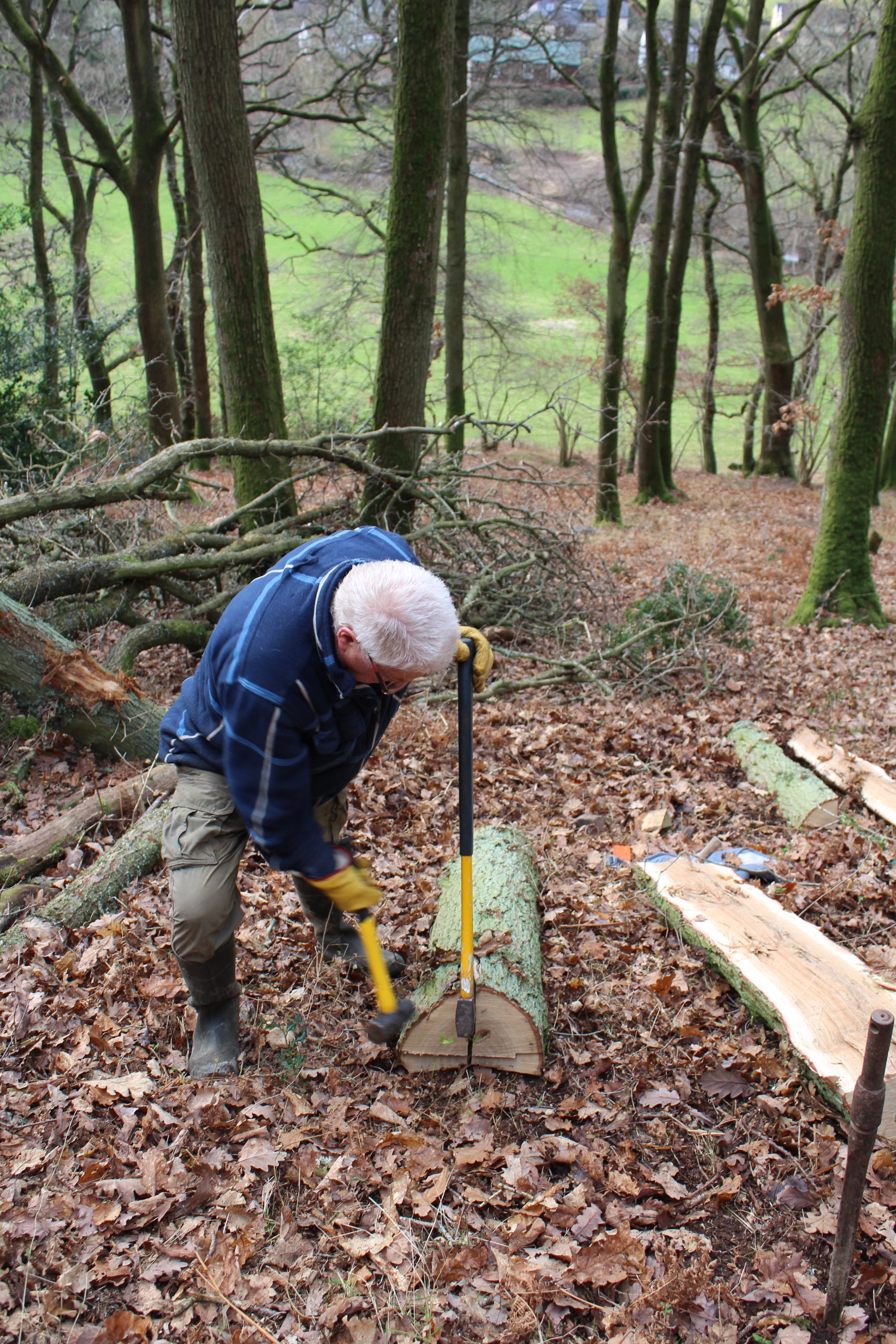
The first set of criteria applies to ensuring that the site is managed safely during felling and timber extraction, and in this case is especially important because of the public footpath running along the bottom of the wood. The felling itself does not present so much of a hazard as it will take place away from the path, but the trunks have to be dragged across the path to a nearby field before being carried across to the road. Our chosen contractor is experienced in such matters and signage will be put in place before felling and extraction take place. This stage is expected to take about two weeks. Although much of the wood is in poor condition, and many of the trees are weakened because of their proximity to each other, we have stipulated that wherever possible trunks will be used for sustainable purposes such as oak fencing. We will leave a very few trees standing in the felling area in the hope that they will grow into mature ‘standards’ and even veterans in many years’ time.
Once felling and extraction are over, the Society will erect deer fencing around the felled area to protect it from deer predation. The intention is to complete this in the winter. After that we must let some time pass to find out how many felled stools regenerate and acorns germinate before we address restocking, which is where the Forestry Commission exercises its other criteria.
In order to provide the optimum conditions for increased biodiversity, instead of the present tree density of about 5-600 stems per hectare, we must reduce this to 400 per hectare which equates to about 80 canopy trees in the first coupe. Sessile Oak (Quercus petraea) will remain the dominant tree species either through regeneration of the stools of felled trees, through natural reseeding, or (less likely, we hope) restocking. However, to mitigate the possible effects of climate change and to provide a safeguard against new tree diseases, we must ensure that 20% of trees (i.e. 16 in the first coupe) are other broadleaf species such as sweet chestnut, small-leaved lime, sycamore, wild cherry, hornbeam and Pedunculate Oak) All licenced trees felled are to be removed quickly and carefully so as to avoid damage to the remaining tree stumps, seedlings or coppice shoots. The land is to be adequately prepared in order to provide suitable conditions for successful establishment and weeded to facilitate natural regeneration or coppice regrowth Any preparation or weeding must be done in a way so as not to damage existing trees. Plants must be protected against damage and be adequately weeded. Any failure or losses should be replaced as necessary to provide the stocking density of not less than 400 stems per hectare evenly distributed over the site.
Over and above this, we will ensure that there is a healthy shrub-layer which will include hazel and some holly, and maybe rowan and hawthorn.
What happens next i.e., when we move on to our next coupe, rather depends on how well the young trees in the first coupe fare. As this is dependent on nature, weather and soil, it is impossible to predict, although our original intention was to create six coupes during the ten-year lifetime of the project.
The FiPL project aims and Forestry Commission requirements are, therefore, completely consistent, and exactly in line with the Society’s ambition for its quillets.
As a Community Benefit Society, of course, we remain keen that our woodland remains available for people to explore, enjoy and understand what we are doing. With the successes reported here, we hope that interest will increase and may even attract more volunteers – for both practical work, monitoring improvements in biodiversity, and with the management and governance of the Society. There is a lot to do, and we are keen to hear from others who would like to be involved.
We will naturally keep shareholders and others informed of progress and from time to time we may put out calls for assistance on specific tasks. We are, of course, pleased to receive comments or questions.


 Redlake Valley Community Benefit Society